
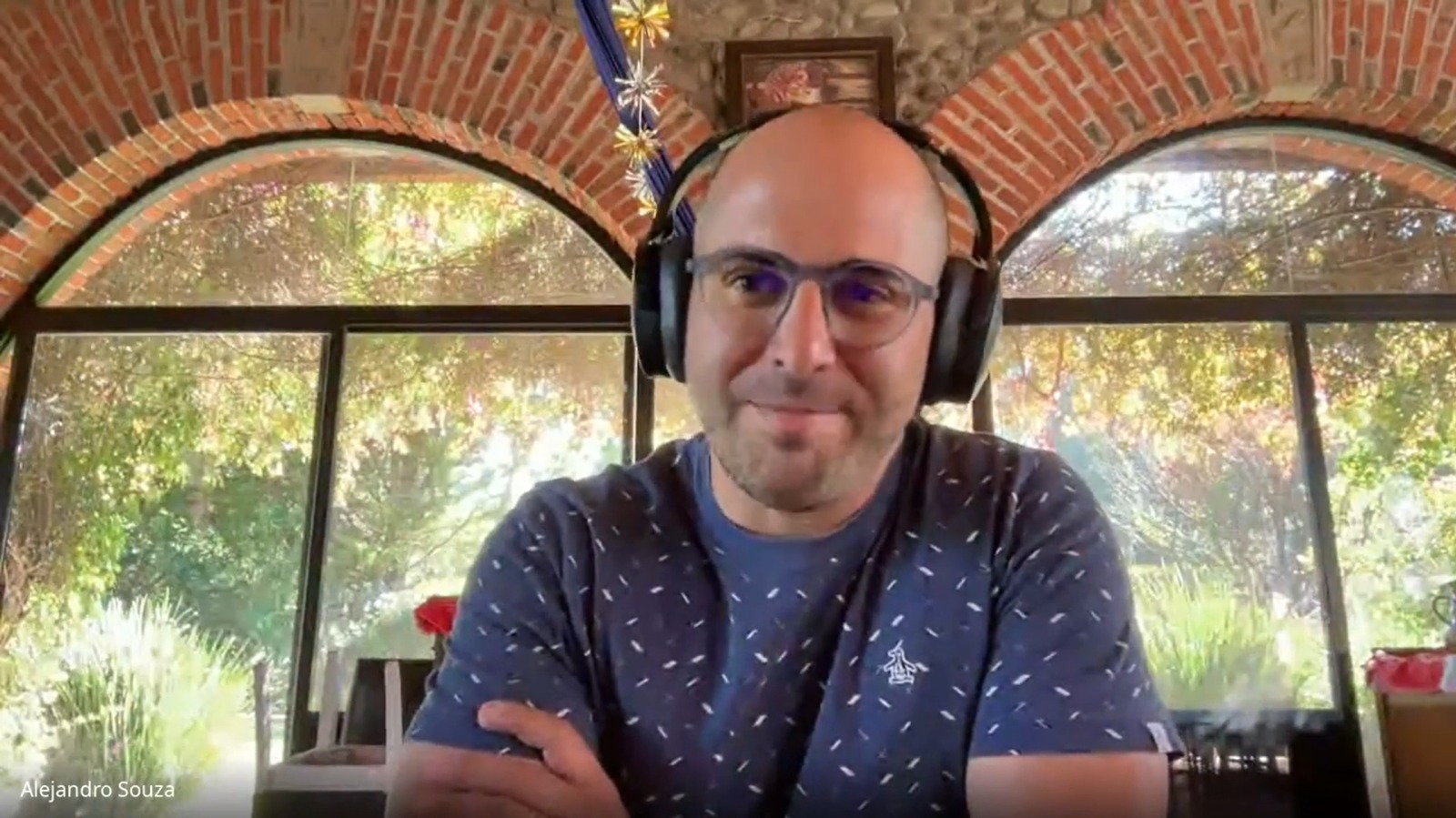
In this Landa Talks episode, we sat down with Alex Souza, a six-time impact founder, LC3 member, teacher, and existential coach who has built and exited companies across six countries, including the social enterprise Pixza in Mexico.
After burnout, a bankruptcy tied to the SVB collapse, and a profound personal reset, Alex created the Unfuckable program to help founders and fractionals build real existential mastery over their own minds — facing what he calls their invisible enemies and reconnecting with who they actually are.
"Your mind is a tricky little enemy. It exists to keep you safe, but it convinces you that you need it to survive. Existential work is learning how to listen beyond it."
Alex calls this existential mastery: learning to observe, rather than fight, the rational fear-based mind. For fractionals and consultants, this matters because independence amplifies whatever inner patterns you already carry. Left unaddressed, those patterns quietly run your pricing, your boundaries, and your relationships.
Alex shared that the real struggle for founders and independent professionals lives inside what he calls the "rational, fear-based mind" — the part of us that learns early the world is unsafe and responds by building defense mechanisms: overachievement, people-pleasing, control.
These aren't character flaws. They're survival strategies quietly steering your decisions, and recognizing them is the starting point of any real existential mastery.
He traced his own pattern back to growing up with abandonment, which planted a belief of "I'm not good enough", a wound he tried to solve externally by building ventures, impact, and success. For fractionals, the same pattern often shows up as tying self-worth to client validation, revenue, or staying constantly busy, instead of to grounded confidence in the craft itself.
One of the most striking stories Alex shared came from his work at Pixza, the social enterprise that hired and empowered formerly homeless youth. He eventually realized the company had become a mirror of his own unresolved trauma — by trying to save others, he was unconsciously trying to save himself.
That pattern led to severe burnout and a full physical collapse; Alex described being hospitalized with salmonella as what felt like a poetic purge of years of accumulated stress. His warning for consultants and operators: when work becomes the place you hide from your own pain, no amount of success will ever feel like enough — and eventually, the body forces a stop.
Alex's estimate: you control roughly 2% of what actually happens in life or business. Clinging to outcomes — exits, revenue goals, recognition — creates constant internal pressure; committing to the process instead makes the work lighter and more playful.
He calls this state becoming "unfuckable", the shift from obsessing over results to showing up fully, with curiosity and presence. It's existential mastery applied directly to business: control what you can observe in yourself, release what you can't control in the outcome.
For fractionals, that might mean focusing on strong relationships, clear offers, and repeatable systems, while accepting that any individual deal may or may not close. Counterintuitively, that detachment tends to produce better decisions and longer-term success.
Alex warned against forcing yourself into predefined paths or rigid frameworks too early. Many people try to squeeze their uniqueness into someone else's structure instead of letting their natural strengths lead. His advice: treat your career or consulting path as an act of self-discovery before it becomes an act of optimization.
For fractionals, that means identifying what feels alive and energizing in the work — a specific kind of problem, a certain type of client, a particular context — before locking in the structure around it. Once that's clear, the structure becomes a support system instead of a cage. Success, in Alex's words, should never come at the cost of well-being; the most resilient careers are built from the inside out.
✅ Existential mastery starts with observing your mind, not fighting it. Most of what feels external is actually internal.
✅ Overachievement, people-pleasing, and control are survival strategies, not character flaws — name them before they run your pricing and boundaries.
✅ Watch for burnout that comes from trying to heal yourself through your work or your clients.
✅ Commit to the process, not the outcome. You control a lot less of the result than you think.
✅ Find what feels alive in your work first. Structure should support that, not cage it.
⚡️ Alex's episode was a reminder that the biggest threat to a fractional career often isn't external — it's the patterns we never stop to name. Existential mastery isn't a detour from building a business; for Alex, it's the foundation that makes one sustainable.
Impact founder and CEO with over 15 years building ventures across the United States, Uganda, Rwanda, Bhutan, Brazil, and Mexico. He has founded 5 companies and achieved 2 successful exits. As founder of Pixza, the world's highest-rated B-Corp in food & beverage, Alex created a model now studied at Harvard and Stanford.
Today, he shares his experience as an international keynote speaker, mentor, coach, consultant, entrepreneurship professor, and author, helping founders build companies that matter. Educated at Babson College and Columbia University, Alex is a LinkedIn Top Voice in Entrepreneurship, recognized among the Top 100 Social Entrepreneurs in Mexico and Top 100 Global Leaders for UN Objectives by Meaningful Business.
